Image: © investingLive
Australian wage growth hits three-year high as unemployment rises
Australia’s wage price index rose 1.1% in the third quarter, the fastest pace since late 2023, while unemployment reached a five-year high, creating a complex policy dilemma for the central bank ahead of key employment data.
- The wage price index increased 1.1% quarter-on-quarter in Q3, exceeding forecasts of 0.9% to 1.0%.
- Annual wage growth accelerated to 3.5%, driven by a 4.75% award wage increase and public sector raises.
- Unemployment hit a five-year high of 4.7%, with major retailers David Jones and Bunnings announcing job cuts.
- Real wages fell 0.4% year-on-year, marking the fourth consecutive quarterly decline.
- Interest rate swaps imply a 75% probability that the RBA has reached its peak rate.
Wage Acceleration and Drivers
The Australian Bureau of Statistics reported that the wage price index rose 1.1% in the third quarter. This result marked the strongest performance since late 2023, breaking a streak of five quarters where growth hovered around 0.8%. The figure also surpassed market expectations, which had ranged between 0.9% and 1.0%.
On an annual basis, wage growth picked up to 3.5% from 3.2%. The private sector saw pay rises of 3.4% over the year, while the public sector accelerated to 3.9%.
Two primary factors drove these increases. The Fair Work Commission’s 4.75% increase in minimum and award wages, implemented in July, lifted private sector pay. Simultaneously, raises for state government frontline workers pushed up public sector wages.
Labor Market Weakness
Despite the surge in pay, the broader labor market is cooling. Unemployment reached a five-year high of 4.7% in September. Layoffs are becoming more widespread, particularly in the retail and hardware sectors.
Department store David Jones announced plans to cut 1,500 jobs by the end of the year. Hardware chain Bunnings also confirmed it would eliminate approximately 230 permanent roles.
For households, the larger pay rises offer some relief after a prolonged period of financial pressure. However, real wages remain under strain. Real wages fell 0.4% year-on-year, marking the fourth consecutive quarterly decline.
Central Bank Dilemma
The central bank raised rates for a fifth time in November, bringing the cash rate to an 18-year high of 4.85%. This decision was partly based on the assessment that the labor market remained tight.
Three board members opposed the move, expressing concern that the economy could be heading for a materially sharper downturn. The current dynamic suggests the bank may need to tolerate a jobless rate higher than its current projections, possibly exceeding the level it considers consistent with steady inflation.
Unless productivity improves, wage gains of this magnitude sit uneasily with inflation returning to the 2% to 3% target band. One economist noted that wage growth and joblessness are likely to remain elevated through 2027. The bank has argued that the labor market is easing, yet pay growth shows little sign of cooling broadly.
Market Reaction and Outlook
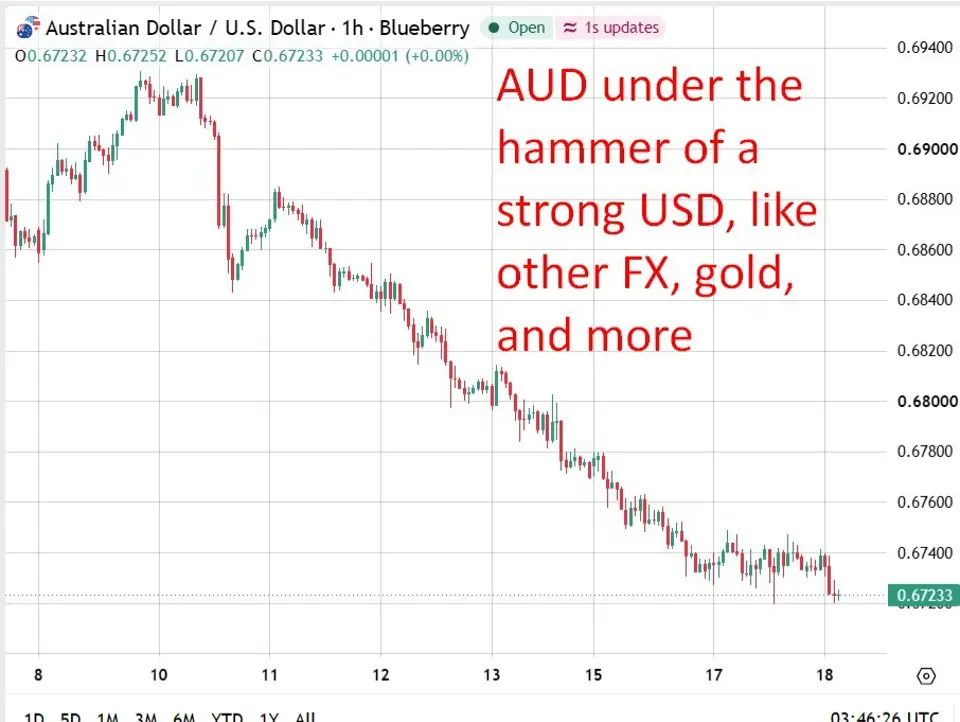
Financial markets largely treated the wage figures as backward-looking data. The Australian dollar barely moved, holding around 0.67, as traders focused on upcoming employment data. Interest rate swaps still imply about a 75% chance that the RBA has finished raising rates.
The market has priced in roughly 20 basis points of easing by the end of 2027.
Key data points to watch include:
- Forecasts point to a rise of 25,000 jobs in October.
- The unemployment rate is expected to remain unchanged at 4.7%.
- A strong jobs report would challenge the view that rates have peaked.
- A weak jobs report would reinforce bets on easing by 2027.
Traders are advised to watch the jobless rate on Thursday more closely than the headline jobs figure.